
Best Portable Power Banks for Travel
Affiliate Disclosure
Mjaffiliate participates in affiliate marketing programs. Some links in this article may be affiliate links. If you purchase through one of these links, we may earn a small commission at no additional cost to you.
Our recommendations are based on official product specifications, portability, charging performance, capacity, practical travel features, and overall value. Prices, availability, colors, and product configurations may vary by country and retailer.
Introduction
A reliable power bank can be one of the most useful travel accessories you carry. Smartphones are now used for boarding passes, hotel reservations, navigation, translation, payments, photography, and communication. When the battery runs out, even a well-planned journey can quickly become stressful.
The best portable power bank for travel should provide enough capacity for your devices without taking up too much space in your backpack or carry-on bag. It should also support modern USB-C fast charging, clearly display its battery capacity, and include dependable protection against overheating, overcharging, and short circuits.
Different travelers need different types of portable chargers. A weekend traveler may only need a compact 10,000mAh model. Someone carrying a tablet or laptop may need 20,000mAh or more and at least 65W of USB-C output. iPhone users may prefer magnetic wireless charging, while business travelers may value built-in cables and several charging ports.
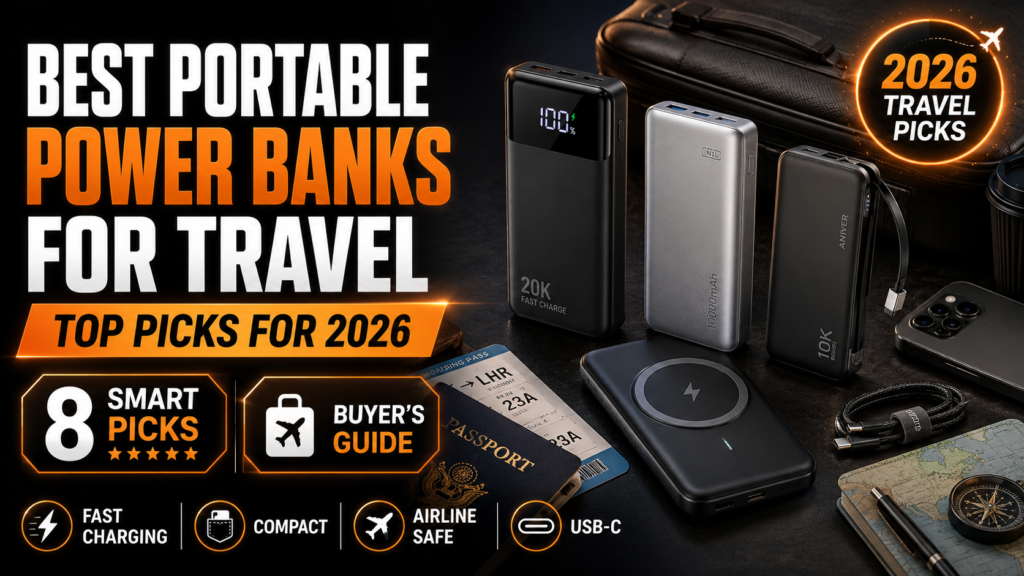
In this guide, we compare eight of the best portable power banks for travel in 2026. The selections cover lightweight chargers, high-output laptop power banks, magnetic models, built-in cables, outdoor travel, and multi-device charging.
Quick Comparison of the Best Travel Power Banks
| Power Bank | Best For | Capacity | Maximum Output | Main Strength |
|---|---|---|---|---|
| Anker Nano Power Bank 10K | Best overall | 10,000mAh | 45W | Retractable USB-C cable |
| Nitecore NB10000 Gen4 | Lightweight travel | 10,000mAh | 22.5W | Ultralight and water-resistant |
| Belkin UltraCharge Pro 10K | iPhone users | 10,000mAh | 30W wired/25W wireless | Fast Qi2 magnetic charging |
| UGREEN Nexode 20K | Multiple devices | 20,000mAh | 130W total | Charges three devices |
| Baseus Blade 2 | Slim laptop charging | 12,000mAh | 65W | Thin bag-friendly design |
| Anker Prime 20K | Business travelers | 20,000mAh | 220W total | High laptop charging power |
| BioLite Charge 100 Max | Families and groups | 25,000mAh | 120W total | Charges up to five devices |
| EcoFlow RAPID 25K | Long trips | 25,000mAh | 170W total | Built-in retractable cables |
Maximum output does not mean every port delivers that amount simultaneously. Charging performance depends on the device, cable, protocol, battery level, and number of connected products.
1. Anker Nano Power Bank 10K – Best Travel Power Bank Overall
The Anker Nano Power Bank 10K is our best overall recommendation for most travelers because it combines practical capacity, fast charging, compact dimensions, and a built-in retractable USB-C cable.
It provides a 10,000mAh capacity and up to 45W single-device USB-C output. Its retractable cable extends to approximately 70 centimetres and stores neatly inside the power bank when it is not being used. Anker also includes a USB-C port, USB-A port, smart battery display, pass-through charging, and up to 30W recharging input. (Anker)
A 10,000mAh power bank is usually sufficient for short trips, commuting, airport waits, and emergency phone charging. The built-in cable also reduces the chance of arriving at your destination without the correct charging cable.
Advantages
- Compact 10,000mAh capacity
- Fast 45W USB-C output
- Durable retractable cable
- Smart battery display
- USB-C and USB-A connections
- Up to 30W fast recharging
- Convenient for everyday travel
Disadvantages
- Not enough capacity for several days of laptop use
- Built-in cable cannot be replaced easily
- Maximum speed depends on device compatibility
- More expensive than basic 10,000mAh models
Best for: Most travelers who want a compact, fast, and convenient charger for smartphones, tablets, and smaller USB-C devices.
2. Nitecore NB10000 Gen4 – Best Lightweight Power Bank
The Nitecore NB10000 Gen4 is designed for travelers who pay close attention to weight. It is particularly useful for hiking, backpacking, camping, and trips where every item in the bag matters.
It has a 10,000mAh battery, weighs approximately five ounces, and offers two USB-C connections. The power bank supports up to 22.5W input and output and has an IPX7 water-resistance rating. Its rated battery energy is 39Wh, comfortably below the standard 100Wh aviation threshold. (Nitecore Store)
Its charging speed is lower than the Anker Nano, but its lightweight construction and water resistance make it more suitable for outdoor travel.
Advantages
- Extremely lightweight
- Compact design
- Two USB-C connections
- IPX7 water resistance
- Clearly stated 39Wh rating
- Good for hiking and backpacking
- Suitable for low-current devices
Disadvantages
- Slower than 45W and 65W alternatives
- Cannot properly power many laptops
- No built-in cable
- Premium price for the capacity
Best for: Backpackers, hikers, and minimalist travelers who value low weight more than maximum charging speed.
3. Belkin UltraCharge Pro 10K – Best for iPhone Users
The Belkin UltraCharge Pro Power Bank 10K is a strong option for travelers who want convenient magnetic charging without connecting a cable every time.
It provides a 10,000mAh capacity, up to 25W Qi2 magnetic wireless charging, and up to 30W through its USB-C connection. It can charge a wired device and a wireless device simultaneously, although power is divided between the two outputs. The design also includes a digital display and built-in stand. (Belkin US)
Magnetic charging is especially convenient while waiting at an airport, using navigation, or watching videos. However, wired USB-C charging remains more efficient and generally creates less heat.
Advantages
- Fast Qi2 magnetic charging
- 30W wired USB-C output
- Built-in viewing stand
- Digital battery display
- Charges two products simultaneously
- Secure magnetic attachment
- Convenient for compatible iPhones
Disadvantages
- Wireless charging produces more heat
- Less efficient than wired charging
- Magnetic charging requires compatible devices or cases
- Higher price than basic power banks
Best for: iPhone and Qi2-compatible phone owners who value convenient magnetic charging.
4. UGREEN Nexode 20K 130W – Best for Multiple Devices
The UGREEN Nexode 20K is suitable for travelers carrying a laptop, tablet, smartphone, earbuds, and other USB-powered accessories.
It offers a 20,000mAh capacity, two USB-C ports, one USB-A port, and up to 130W total output. A single USB-C connection can deliver up to 100W, while the smart display shows remaining capacity and real-time charging information. The power bank weighs approximately 480 grams. (UGREEN UK)
The large capacity provides more flexibility than a 10,000mAh model, but it also creates additional weight. It is most useful for business trips and long journeys rather than casual daily carrying.
Advantages
- Large 20,000mAh capacity
- Up to 100W from one USB-C port
- 130W combined output
- Charges three devices
- Detailed smart display
- Suitable for many USB-C laptops
- Fast 65W power-bank recharging
Disadvantages
- Heavier than phone-only chargers
- Column design may feel bulky
- Requires a suitable high-power cable
- Higher-output chargers cost more
Best for: Business travelers and remote workers who need to charge several devices.
5. Baseus Blade 2 – Best Slim Power Bank for Laptops
The Baseus Blade 2 is designed to fit flat against a laptop inside a backpack or travel bag. Its shape is very different from the thicker rectangular designs used by many high-output power banks.
It has a 12,000mAh capacity, two USB-C connections, up to 65W output, and up to 60W input. It measures approximately 0.4 inches thick and weighs around 339 grams. Its display can show charging information, while the Baseus application offers additional monitoring and customization. (Baseus US)
The 65W output can charge many lightweight laptops, tablets, gaming devices, and smartphones. However, 12,000mAh provides less total energy than a 20,000mAh model.
Advantages
- Very slim design
- 65W laptop charging
- Two USB-C connections
- Detailed digital display
- Fast 60W recharging
- Easy to store beside a laptop
- Includes a high-power USB-C cable
Disadvantages
- Wide shape may not fit small pockets
- Lower capacity than 20,000mAh alternatives
- Only two charging connections
- Not enough for repeated full laptop charges
Best for: Students and business travelers who want a thin charger that fits neatly inside a laptop bag.
6. Anker Prime 20K 220W – Best for Business Travel
The Anker Prime Power Bank 20K is built for demanding devices and travelers who regularly work away from electrical outlets.
It provides 20,000mAh capacity, two USB-C connections, one USB-A connection, and up to 220W total output. Its compact design includes a smart display that monitors battery level, power distribution, and charging status. (Anker)
This power bank can support laptops, tablets, smartphones, portable gaming devices, and professional equipment. The trade-off is that it is heavier and more expensive than a standard travel charger.
Advantages
- Very high 220W total output
- Large 20,000mAh battery
- Two powerful USB-C connections
- USB-A support
- Smart charging display
- Suitable for laptops
- Strong multi-device performance
Disadvantages
- Expensive
- Heavier than ordinary phone chargers
- High output requires compatible cables
- Excessive for travelers carrying only a phone
Best for: Professionals who need to charge laptops and several devices during flights, meetings, and long workdays.
7. BioLite Charge 100 Max – Best for Families and Groups
The BioLite Charge 100 Max is a versatile option for families, groups, and travelers carrying several types of technology.
It includes a 25,000mAh battery rated at 91.3Wh, two high-power USB-C connections, an additional USB-C connection, USB-A, and a wireless charging surface. It can produce up to 120W total output and charge as many as five products simultaneously. (BioLite)
Its clearly displayed 91.3Wh rating is useful when traveling by air because airport and airline staff may need to confirm the battery’s energy capacity.
Advantages
- Large 25,000mAh capacity
- Clearly marked 91.3Wh rating
- Charges up to five products
- 100W USB-C laptop output
- Wireless charging surface
- Multiple connection types
- Suitable for families and groups
Disadvantages
- Large and relatively heavy
- More expensive than basic chargers
- Wireless charging adds heat
- Too large for comfortable pocket use
Best for: Families, groups, photographers, and travelers carrying several devices.
8. EcoFlow RAPID 25K – Best for Long Trips
The EcoFlow RAPID Power Bank 25K is designed for longer journeys and travelers who want high output without carrying several separate cables.
It provides 25,000mAh capacity, up to 170W total output, and integrated 100W built-in and retractable USB-C cables. It is intended for charging laptops, tablets, smartphones, and other high-power devices. (EcoFlow CA)
The integrated cables are a major convenience, especially during airport transfers or train journeys. However, travelers should inspect the Watt-hour rating printed on the exact model and confirm their airline’s rules before departure.
Advantages
- Large 25,000mAh battery
- Up to 170W total output
- Built-in charging cable
- Retractable USB-C cable
- Suitable for laptops and tablets
- Reduces the need for separate cables
- Good for long trips
Disadvantages
- Heavier than 10,000mAh chargers
- Built-in cables are difficult to replace
- Takes more space in a carry-on bag
- Airline rules should be checked before travel
Best for: Long-distance travelers who carry laptops and want integrated cables.
Power Bank Rules for Air Travel in 2026
Power banks should be placed in carry-on luggage, not checked baggage. TSA specifically lists portable chargers as permitted in carry-on bags and prohibited in checked bags. (Transportation Security Administration)
ICAO rules applicable from March 27, 2026 state that power banks must not exceed 100Wh, must be individually protected against short circuits, and must be transported in carry-on baggage. The updated standard limits passengers to two power banks, says they must not be recharged aboard the aircraft, and advises that they should not be used to charge another device during the flight. (IATA)
Individual airlines may apply stricter rules. Before traveling:
- Check the Watt-hour rating printed on the power bank.
- Carry no more than the number allowed by your airline.
- Keep the charger in your hand luggage.
- Protect its connections from metal objects.
- Do not use a swollen, damaged, recalled, or overheating battery.
- Follow cabin-crew instructions about storage and use.
A power bank with an unreadable or missing capacity label may be rejected during security or boarding.
How to Choose the Best Power Bank for Travel
Choose the Right Capacity
A 5,000mAh charger is suitable for emergency use. A 10,000mAh model provides a better balance for most phone users. A 20,000mAh or 25,000mAh power bank is more appropriate for long trips, tablets, laptops, and several devices.
Check the Watt-Hour Rating
Airlines regulate batteries using Watt-hours rather than only milliamp-hours. Select a power bank with its Wh rating clearly printed on the product.
Match the Output to Your Device
Most phones work well with 20W to 45W charging. Tablets and lightweight laptops may require 45W to 65W, while larger laptops may benefit from 100W or more.
A powerful charger cannot force excessive energy into a properly designed device; compatible devices negotiate the charging level. However, you still need a suitable cable.
Consider Weight and Shape
A large battery may appear portable in photographs but feel heavy after several hours. Lightweight travelers should prioritize 10,000mAh models. Business travelers may accept additional weight in exchange for laptop charging.
Look for Built-In Cables
Built-in cables are convenient and reduce packing. The disadvantage is that repairing or replacing a damaged integrated cable may be difficult.
For additional travel technology, read our guide to the Best Wireless Earbuds to Buy in 2026.
Students and remote workers can also explore the Best Budget Laptops for Students in 2026.
Before ordering, review our guide to the 10 Best Online Shopping Websites to Discover Quality Products in 2026.
Frequently Asked Questions
What is the best portable power bank for travel?
The Anker Nano Power Bank 10K is the best overall option for most travelers because it combines a compact design, 45W charging, a smart display, and a retractable USB-C cable.
Can power banks go in checked luggage?
No. Lithium-ion power banks must be carried in hand luggage rather than checked baggage. (Transportation Security Administration)
Is a 20,000mAh power bank allowed on an airplane?
Many 20,000mAh models are below 100Wh and may be permitted in carry-on baggage. Always check the Wh rating printed on the specific device and confirm your airline’s policy.
How many power banks can I carry in 2026?
ICAO’s March 2026 amendment limits passengers to two power banks. Airlines can impose additional restrictions, so check with your carrier before departure. (IATA)
Can a power bank charge a laptop?
Yes, when it supports the correct USB-C Power Delivery output. Many lightweight laptops work with 45W or 65W, while more powerful models may require 100W or more.
Is 10,000mAh enough for travel?
It is enough for most weekend trips and daily excursions, especially when the main purpose is charging a smartphone. Longer journeys or several devices may require 20,000mAh or more.
Are wireless power banks better than wired models?
Wireless models are convenient, but wired charging is usually faster and more efficient. Magnetic wireless charging is most useful for convenience rather than maximum performance.
Final Verdict
The best portable power bank for travel depends on the devices you carry and the length of your journey.
The Anker Nano 10K offers the best overall combination of portability, charging speed, and cable convenience. The Nitecore NB10000 Gen4 is ideal for travelers who want the lightest practical option, while the Belkin UltraCharge Pro is best for magnetic iPhone charging.
The UGREEN Nexode and Anker Prime are stronger choices for business travelers carrying laptops. The slim Baseus Blade 2 fits neatly inside a laptop bag, while the BioLite Charge 100 Max and EcoFlow RAPID 25K provide more capacity for families and longer trips.
Before ordering, confirm the power bank’s Watt-hour rating, check your airline’s latest battery policy, and choose a model that provides enough output without adding unnecessary weight.
Ready to stay powered during your next journey? Use the price links above to compare current offers and choose the travel power bank that best matches your devices, luggage, and charging needs.